
Do Charities Pay Credit Card Fees? What $10K Really Costs
By Griffin · October 22, 2026 · 6 min read
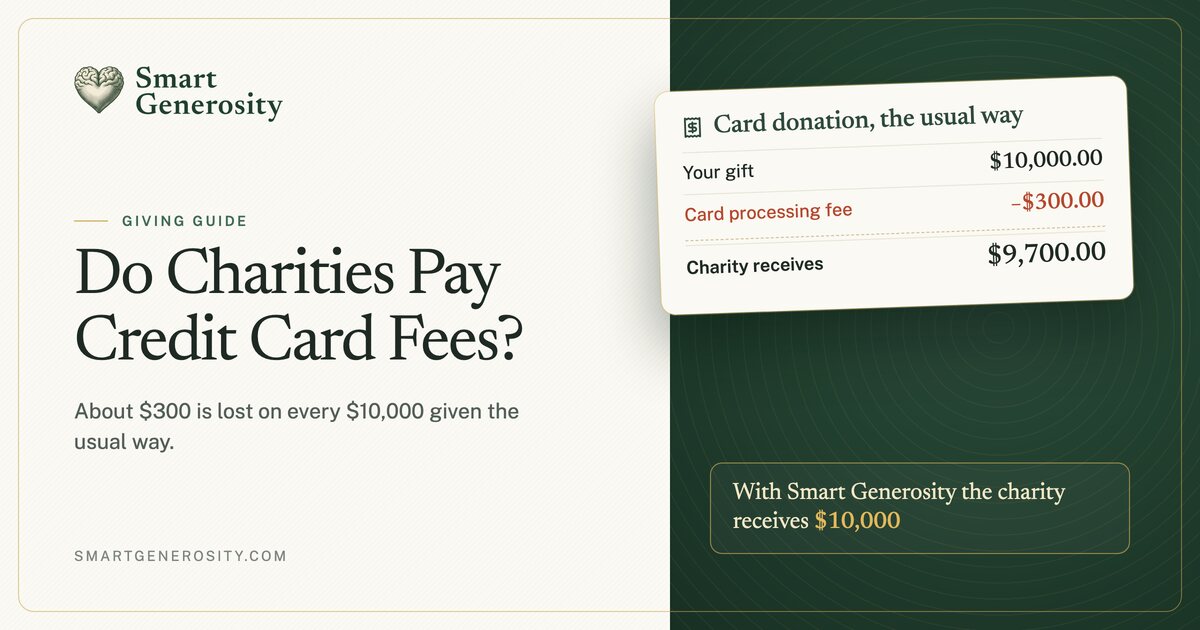
Yes. On a typical card donation the charity pays the processing fee, usually 2–3.5% of the gift plus a small per-transaction charge, deducted before the money reaches its bank account. On a $10,000 card donation, that's about $300 that never reaches the cause, unless the donation form asks you to add about 3% to cover it. With Smart Generosity, neither happens: nothing comes out of the donation and you pay no fees.
Key takeaways
- Usually either the charity receives about 3% less or you're asked to add about 3%. On $10,000, that's about $300 lost by the charity or added by you.
- With Smart Generosity, nothing comes out of the donation and you pay no fees, so the charity receives 100%.
- The exact fee on a $10,000 card gift is commonly $200–$350, depending on the charity's rates and your card.
- Premium rewards cards often cost the charity more to accept than basic cards.
- Ticking "cover the fees" moves the cost to you rather than removing it.
Who actually pays the fee on a card donation?
A card payment passes through several hands, and each takes a share:
- Your card issuer (the bank behind your card) receives most of the fee, known as interchange. This is a big part of what pays for your rewards.
- The card network, such as Visa, Mastercard or American Express, charges its own assessment.
- The charity's payment processor adds its markup for moving the money.
- Donation-form software, if the charity uses it, may add a platform fee on top.
The charity gets one combined deduction. You see $10,000 on your statement, and the charity's bank deposit is smaller.
How much does a $10,000 card donation cost the charity?
Here's what the fee looks like at three illustrative rates. A per-transaction fee of $0.30 is a common figure, though the actual amount varies.
| Illustrative processing rate | Fee on a $10,000 gift | Charity receives |
|---|---|---|
| 2.2% + $0.30 | $220.30 | $9,779.70 |
| 2.9% + $0.30 | $290.30 | $9,709.70 |
| 3.5% + $0.30 | $350.30 | $9,649.70 |
Illustrative examples, not a quote. The actual cost depends on the charity's processor, contract, card type and any platform fees.
The costs add up for donors who give several times a year. If you give $50,000 by card over a year and the average cost is 2.9%, about $1,450 of your generosity goes to payment companies instead of the causes you chose.
Keep that $300 with the charity. With Smart Generosity, nothing comes out of your donation and you pay no fees, so a $10,000 card gift arrives as $10,000. Apply in 3 minutes to see which option fits your giving, whether you give $10,000 at a time or less.
Why do some cards cost charities more than others?
Interchange rates vary by card type. Premium rewards cards and business cards generally carry higher interchange than basic cards. So the cards that earn you the most rewards are often the most expensive for the charity to accept. That's not a reason to feel guilty about your rewards card. It's simply how those rewards are paid for.
Some charities negotiate lower nonprofit rates with their payment processor, but even then most still pay around 2–3% on every card gift. Lower is not zero: on a large gift, it's still real money that never reaches the cause.
Can't the charity just treat it as a cost of doing business?
Many do. Accepting cards often helps charities raise more online, and for a $50 gift a fee of about $1.75 is a reasonable price for the convenience. Large gifts are where it becomes awkward. Processing a $10,000 gift is barely more work than processing a $100 gift, yet a percentage-based fee makes it about 100 times more expensive. Some charities limit how much they accept by card, or ask major donors to send a check or wire instead, for exactly this reason.
What about the "cover the fees" option?
Many donation forms invite you to add a few percent so the charity receives the full amount. It's a kind gesture, and the extra you pay to the charity is generally part of your deductible gift. But look at what has happened: on a $10,000 gift, you now pay roughly $10,300 to get $10,000 to the charity. The fee still exists. Only the person paying it has changed.
| Option | You pay | Charity receives | Fees paid to processors |
|---|---|---|---|
| Standard card gift | $10,000 | About $9,700 | About $300 |
| "Cover the fees" ticked | About $10,300 | About $10,000 | About $300 |
| Method Smart Generosity members learn | $10,000 | $10,000 | $0 to you or the charity |
Rounded, using an illustrative rate of about 3%.
Are other payment methods cheaper for the charity?
Usually, yes, but you give up something:
- Checks cost the charity very little to deposit, but they earn you nothing, can take days to arrive by mail and can be lost or stolen.
- Bank transfers and wires are inexpensive or carry a modest flat fee, but they earn no rewards, and wires need careful verification to avoid fraud.
- Gifts of appreciated stock can be very tax-efficient for you, though the charity needs a brokerage account to receive them.
We compare all of these in the best way to donate a large amount to charity. If rewards are part of your reason for using a card, see credit card points for charitable donations.
How can a donor give by card without the charity losing the fee?
Most donors assume they have to choose between two things: earn rewards and let the charity absorb a fee, or skip the rewards and send a check. There's a third path. Smart Generosity members learn a way to give by credit card to any US 501(c)(3) charity where 100% of the gift reaches the charity, no fees come out of the donation, there are no ongoing fees, and they keep their card's points, miles or cash back. The training takes about 20 minutes. We've used this approach to give more than $3 million since 2014, with no card fees for the charities or for us. The full picture is in our guide on how to donate to charity with a credit card with no fees, and the tax side is covered in are credit card donations tax deductible.
You can learn more about the membership on the Smart Generosity homepage.
Want every dollar to reach the cause? The usual choice is about 3% lost by the charity or about 3% added by you. With Smart Generosity, it's neither: the charity receives 100% and you pay no fees. Apply in 3 minutes to see which option fits your giving.
Frequently asked questions
Do charities pay credit card processing fees?
Yes. When you donate by card, the charity's payment processor normally deducts its fee before the money reaches the charity's bank account. Typical card processing runs roughly 2 to 3.5 percent plus a small per-transaction fee, so a charity usually receives somewhat less than the amount you gave unless the fee is covered another way.
How much does a charity lose on a $10,000 credit card donation?
At typical rates of roughly 2 to 3.5 percent plus a per-transaction fee, a $10,000 card gift usually costs the charity somewhere around $200 to $350. Charities with discounted nonprofit pricing may pay less, and premium or rewards cards can cost them more. The exact figure depends on the charity's processor and contract.
Should I check the "cover the fees" box when I donate?
It's a generous choice that makes sure the charity nets your intended amount, but it raises your cost by the fee, often around 3 percent. On a $10,000 gift that can mean several hundred dollars more out of pocket. Some donors prefer an approach where the charity receives 100 percent without the donor paying extra.
Smart Generosity is an independent education company and is not affiliated with any charity, bank or card issuer. Fee figures are general ranges, not quotes. Tax points are general information, not tax advice; check with your tax professional.