
Are Credit Card Donations Tax Deductible? Timing & Receipts
By Griffin · October 27, 2026 · 7 min read
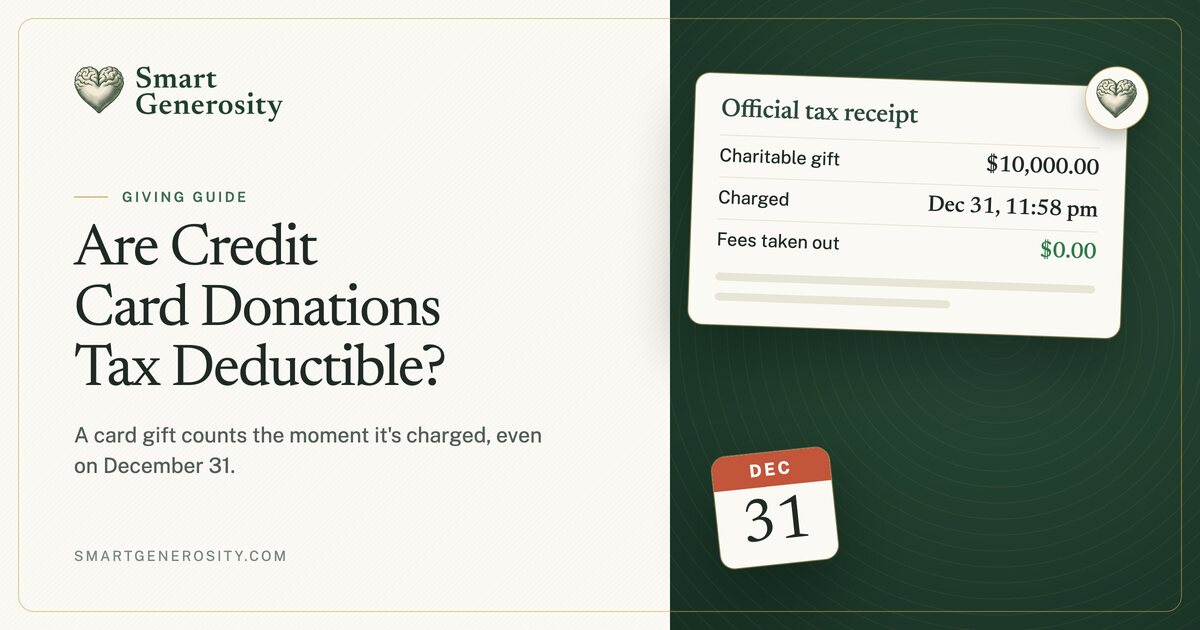
Generally, yes. A credit card gift to a qualifying US charity is treated like a cash contribution, and it's generally deductible in the year the charge is made, even if you pay the card bill the following year. It counts the moment the card is charged, even at 11:59 pm on December 31. Keep the official receipt, which arrives by email right after you give. One cost to plan for: usually either the charity receives about 3% less or you add about 3% to cover fees (about $300 on $10,000). With Smart Generosity, nothing comes out of the donation and you pay no fees.
This article is general information, not tax advice; check with your tax professional.
Key takeaways
- Card gifts to qualifying charities are generally treated as cash contributions.
- Usually the charity loses about 3% of a card gift, or you add about 3% to cover it. With Smart Generosity, nothing comes out of the donation and you pay no fees.
- The deduction counts on the date of the card charge, even at 11:59 pm on December 31, not when you pay your card bill.
- Keep the official receipt. With the method members learn, an official digital tax receipt arrives by email the moment the payment goes through.
- Paying by card doesn't change your deduction, and the points, miles or cash back don't reduce it.
Are credit card donations treated like cash?
Yes. For federal tax purposes, a contribution charged to a credit card is generally treated the same as a gift by check or bank transfer. The same conditions apply:
- The recipient must be a qualified organization. Most US 501(c)(3) public charities qualify. You can check an organization with the IRS Tax Exempt Organization Search.
- Some gifts never qualify. Gifts to individuals, personal crowdfunding campaigns, political campaigns and most foreign charities generally aren't deductible.
- You can only deduct what you gave. If you received something in return, such as a gala dinner, you generally deduct only the amount above the value of what you received.
Which tax year does a credit card donation count in?
IRS guidance says contributions charged to a credit card are deductible in the year you make the charge, even if you pay the card balance the following year. Here's how that compares with other methods:
| How you give | When the gift generally counts |
|---|---|
| Credit card | The date of the charge |
| Check | The date you mail it, if it later clears |
| Bank transfer or wire | When the funds are transferred |
| Pledge | Only when you actually pay it |
This is one reason cards are popular for year-end giving. A gift charged as late as 11:59 pm on December 31, 2026 counts for 2026, even though the statement isn't due until 2027. The charge date is what matters. That said, we don't recommend testing it to the second. Click a few seconds after midnight and your generosity officially belongs to next year. Give yourself a comfortable cushion, and if it's a large gift, tell your card issuer ahead of time so a fraud hold doesn't stop it at the last minute.
What records do you need for a card donation?
The requirements depend on the size of each single contribution:
| Single gift | What you generally need |
|---|---|
| Under $250 | A bank record (a card statement counts) or a written communication from the charity showing its name, the date and the amount |
| $250 or more | A written acknowledgment from the charity stating the amount, whether you received any goods or services in return, and a good-faith estimate of their value if you did |
| Over $75 with something received in return | A disclosure from the charity of the value of what you received; you deduct only the excess |
At $250 or more, your card statement alone isn't enough, so keep the official receipt. This is rarely extra work: most organizations email one automatically, and with the method Smart Generosity members learn, an official digital tax receipt arrives the moment the payment goes through. If a receipt doesn't arrive, ask for it before tax season.
Separate gifts aren't added together for the $250 threshold. Two $200 gifts on different days are two gifts under $250.
Giving before year-end? On a $10,000 card gift, the usual way costs about $300, lost by the charity or added by you. With Smart Generosity, nothing comes out of your donation and you pay no fees. Apply in 3 minutes to see which option fits your giving, whether you give $10,000 at a time or less.
Does paying by card change your deduction?
No. Your deduction is based on how much you give, whether you give by cash, check or credit card. Cash and checks simply earn you nothing along the way. A card earns points, miles or cash back on money you were already going to give.
The catch is the usual card fee. Normally the charity loses about 3%, or the donation form asks you to add it. With Smart Generosity the fees are covered by a third party, so there are zero fees on your donation and 100% goes to the charity. How much of your giving you can deduct depends on your own tax situation, so ask your tax preparer about that part.
Do fees, interest or rewards change the deduction?
- Covering the charity's fee. If you choose to add the processing fee and pay it to the charity, the extra is generally part of your gift. See Do charities pay credit card fees?
- Fees paid to someone other than the charity. Charges kept by a third party, rather than received by the charity, may not be deductible.
- Card interest. Interest on a balance you carry isn't a charitable contribution.
- Rewards. Points, miles and cash back come from your card issuer, not the charity, and don't reduce your deduction. More on earning them in credit card points for charitable donations.
What's a good checklist for a large year-end card gift?
- Confirm the charity's status with the IRS Tax Exempt Organization Search.
- Check your credit limit and tell your issuer about the large charge in advance.
- Give by December 31. The charge date is what counts, even at 11:59 pm.
- Save the charity's written acknowledgment as a PDF with your tax records.
- Record the charity's name, EIN, date and amount in one place.
- Pay the card in full.
- Give your tax professional the acknowledgment and your summary.
If you're giving to several organizations, our guide on how to donate to multiple charities at once suggests a simple record-keeping layout.
Where does Smart Generosity fit in?
Most donors who give large amounts by card accept a trade-off: either the charity receives about 3% less, or they add about 3% to cover the fees. Smart Generosity members learn a way to give by credit card to any US 501(c)(3) charity where 100% of the gift reaches the charity, no fees come out of the donation, there are no ongoing fees, and they keep their card rewards. We've used this approach to give more than $3 million since 2014, with no card fees for the charities or for us. Read how to donate to charity with a credit card with no fees for the bigger picture, or compare methods in the best way to donate a large amount to charity.
Give the full amount, keep the rewards. With Smart Generosity, the charity receives 100% instead of about 97%, and you pay no fees. Apply in 3 minutes to see which option fits your giving.
Frequently asked questions
Are credit card donations tax deductible?
Generally, yes. A gift charged to a credit card to a qualifying US 501(c)(3) charity is treated like a cash contribution, so it can be deductible on the same terms as a check, as long as you keep proper records. This is general information, not tax advice; check with your tax professional.
If I donate by credit card in December but pay the bill in January, which year counts?
Generally the year the charge is made. IRS guidance says a contribution charged to a credit card is deductible in the year you make the charge, even if you pay the card bill the following year. It counts the moment the card is charged, so even a gift at 11:59 pm on December 31 counts for that year.
What receipt do I need for a credit card donation of $250 or more?
Keep the official receipt from the organization you gave to. For a single gift of $250 or more, a card statement alone isn't enough, so that receipt matters. Most organizations email one right away, and with the method Smart Generosity members learn, an official digital tax receipt arrives by email the moment the payment goes through. That receipt is what you give your tax preparer.
Smart Generosity is an independent education company and is not affiliated with any charity, bank or card issuer. This article is general information, not tax advice; check with your tax professional.