
Best Way to Donate a Large Amount to Charity: Card vs Check
By Griffin · October 31, 2026 · 6 min read
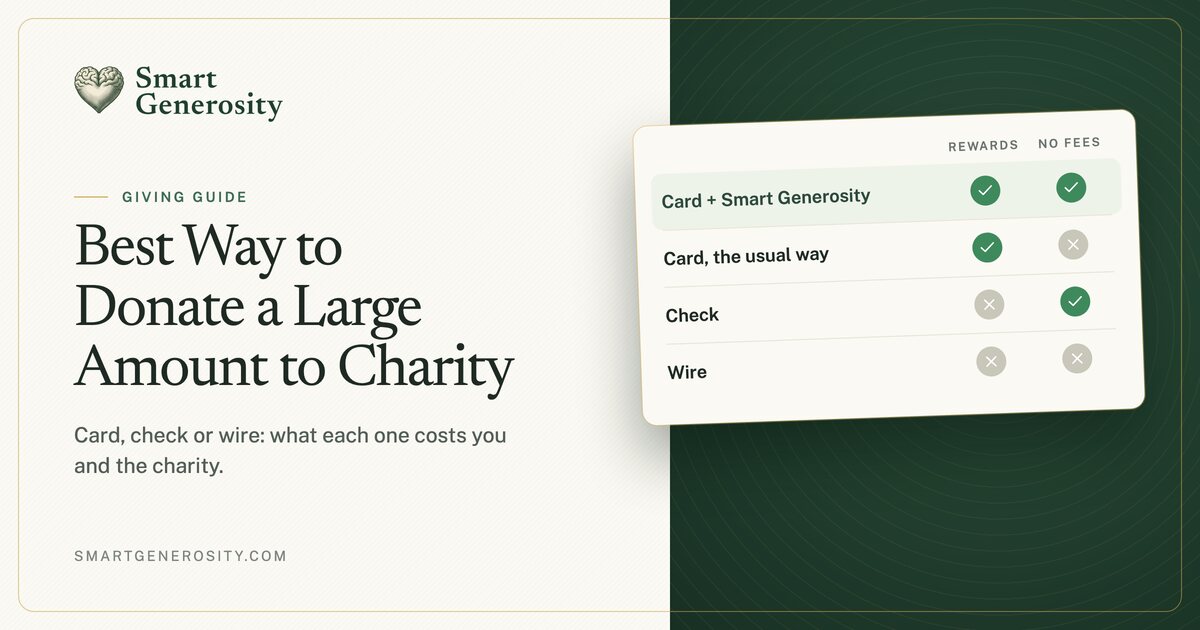
The best way to donate a large amount to charity depends on what you're giving. For long-held appreciated stock, giving the shares directly is often the most tax-efficient option. For cash, a credit card earns rewards, but done the usual way either the charity receives about 3% less or you're asked to add about 3%: about $300 on $10,000. With Smart Generosity, you get the card rewards, nothing comes out of the donation and you pay no fees. Checks and wires cost little but earn nothing and carry their own risks.
Key takeaways
- Judge each method on five things: how much reaches the charity, your total cost, speed, tax treatment and rewards.
- A standard card gift earns rewards, but the charity loses about 3%, or you add about 3% to cover it. On $10,000, that's about $300.
- With Smart Generosity, you give by card, nothing comes out of the donation, you pay no fees and you keep your rewards.
- Checks and bank transfers are cheap but earn no rewards; wires need careful fraud checks.
- Appreciated stock held more than a year is often the most tax-efficient asset to give.
What matters most when you make a big gift?
When a gift reaches five figures, small percentages become real money. Weigh each method against these five questions:
- How much actually reaches the charity?
- What does it cost you, including fees, lost rewards and taxes?
- How fast and certain is it? Year-end deadlines leave little room for delays.
- How is it treated for tax purposes?
- Does it earn anything for you, such as points, miles or cash back?
How do card, check, wire and stock compare?
| Method | Cost to the charity | Cost to you | Rewards | Speed | Tax notes (general) |
|---|---|---|---|---|---|
| Standard credit card gift | Roughly 2–3.5% plus a per-transaction fee | NoneUnless you cover the fee | YesUsually at your base rate | Minutes | Cash gift; generally counts in the year of the charge |
| Credit card, using the method Smart Generosity members learn | None100% reaches the charity | NoFees and no ongoing fees | Yes | Charity usually receives it within a month or two, by direct transfer or check | Counts the moment the card is charged, even 11:59 pm on Dec 31; official digital receipt by email right away |
| Check | Very little | Postage, or a courier for large checks | No | Days to weeks | Generally counts when mailed, if it clears |
| ACH bank transfer | Very little | Usually none | No | Usually 1–3 business days | Generally counts when the funds are transferred |
| Wire transfer | Sometimes an incoming wire fee | An outgoing wire fee, often around $25–$45 per wire depending on your bank | No | Usually same day | Generally counts when the funds are transferred |
| Appreciated stock held more than one year | Small brokerage costs when sold | Usually none | No | Several days to transfer | Generally deduct fair market value and avoid capital gains tax on the appreciation; lower AGI limits apply |
General patterns only. This is general information, not tax advice; check with your tax professional.
When is a credit card the best choice?
For a cash gift, a card is hard to beat on convenience. It's fast, it's well documented, it's easy to time before December 31, and it earns rewards on money you were going to give anyway. On $10,000, a 2% card earns $200. Our guide to credit card points for charitable donations explains how issuers treat donations.
The weakness is fee leakage. On a standard card gift, the charity's processor takes its share before the money arrives, typically around $200 to $350 on $10,000. Covering the fee yourself just moves the cost to you. The details are in Do charities pay credit card fees?
That's the gap Smart Generosity fills. Members learn a way to give by credit card to any US 501(c)(3) charity, with 100% of the gift reaching the charity, no fees coming out of the donation, no ongoing fees, and their card's points, miles or cash back intact. It takes about 20 minutes to learn. We've used this approach to give more than $3 million since 2014, earning significant points and miles with no card fees for the charities or for us. For the full overview, see how to donate to charity with a credit card with no fees.
Giving cash this year? With Smart Generosity, nothing comes out of your donation and you pay no fees, so a $10,000 card gift arrives as $10,000 and you still earn the rewards. Apply in 3 minutes to see which option fits your giving, whether you give $10,000 at a time or less.
When is a check or wire the better choice?
- The charity asks for it. Some organizations prefer checks or wires for major gifts, or cap what they accept by card.
- The gift is larger than your card limit. For very large gifts, a wire or transfer may simply be practical.
- You don't care about rewards and want the lowest possible cost to everyone.
Each has a risk to manage. Checks sent by mail can be stolen and altered, so consider a tracked courier for large amounts. Wires are fast and final, so confirm the charity's wire instructions by phone, using a number you find yourself rather than one in an email. Changed instructions are a common route for fraud.
When does donating stock beat giving cash?
If you hold stock, mutual funds or ETFs that have risen in value and that you've owned for more than a year, giving the shares directly is often the most tax-efficient gift you can make. Here's an illustrative example:
- You bought shares for $20,000, and they're now worth $50,000.
- If you give the shares directly, you can generally deduct their $50,000 fair market value, and nobody pays capital gains tax on the $30,000 gain.
- If you sell first and give the cash, you generally owe capital gains tax on the $30,000 gain, which leaves less for the charity, for you or for both.
There are a few caveats. Deductions for appreciated property given to public charities are generally limited to 30% of AGI, with a five-year carryforward. Not every charity can accept stock directly. And if a holding has fallen in value, it's usually better to sell it, keep the loss for tax purposes, and give cash.
This is general information, not tax advice; check with your tax professional.
Can you combine methods?
Yes, and many experienced donors do. A common pattern is to give appreciated stock where the tax benefit is greatest and give the cash portion by card to earn rewards. If you're spreading a large amount across several organizations, see how to donate to multiple charities at once. For the timing and receipt rules that apply to card gifts, read are credit card donations tax deductible.
What's the smartest choice overall?
There isn't one right answer for every gift, but there is a clear rule of thumb. Give appreciated assets as assets. Give cash in the way that gets 100% of it to the charity at the lowest cost to you, and if you can earn rewards along the way, do. For cash gifts, that's what Smart Generosity members do.
Make your next large gift count in full. No more choosing between the charity losing about 3% and you adding about 3%: with Smart Generosity, nothing comes out of the donation and you pay no fees. Apply in 3 minutes to see which option fits your giving.
Frequently asked questions
What is the best way to donate a large amount to charity?
It depends on what you're giving. For long-held appreciated stock, donating the shares directly is often the most tax-efficient choice. For a cash gift, a credit card can earn rewards, but standard card gifts lose roughly 2 to 3.5 percent to fees unless you use an approach where 100 percent reaches the charity.
Is it better to donate by check or credit card?
A check costs the charity almost nothing to process but earns you no rewards and can be slow or lost in the mail. A standard card gift earns rewards but usually costs the charity a processing fee. There is a way to get card rewards without that fee, whatever the size of the gift.
Is wiring money to a charity safe?
Wires are fast and final, which is both their strength and their risk. Before sending, confirm the charity's wire instructions by calling a phone number you find independently, not one in an email, because wire fraud often starts with altered instructions. Expect a bank fee to send, and sometimes a fee for the charity to receive.
Smart Generosity is an independent education company and is not affiliated with any charity, bank or card issuer. This article is general information, not tax or financial advice; check with your tax professional.