
How to Donate to Multiple Charities at Once
By Griffin · October 29, 2026 · 6 min read
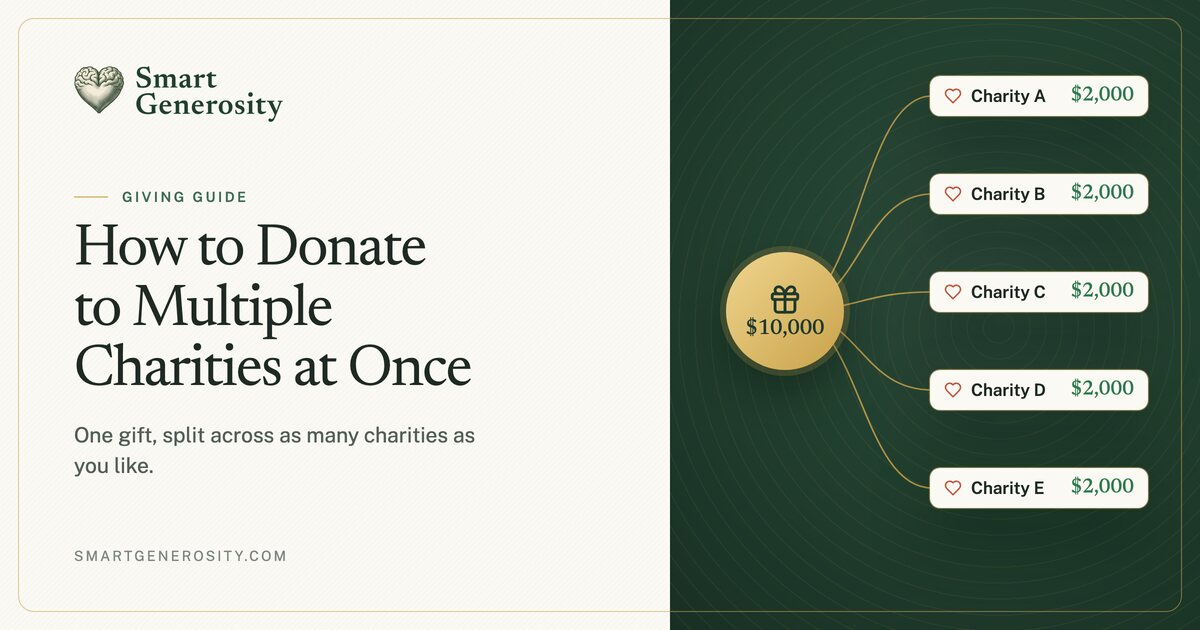
You can donate to multiple charities at once in three main ways. You can make one contribution to a giving vehicle, such as a donor-advised fund, and direct grants from it. You can use a giving platform that lets you pick several charities in one checkout. Or you can make separate direct gifts in one planned sitting. If you pay by card, watch the fees: usually each charity receives about 3% less, or you're asked to add about 3%, which is about $300 on every $10,000. With Smart Generosity, nothing comes out of the donation and you pay no fees.
Key takeaways
- Bundling your giving saves time, simplifies records and makes it easier to give with a plan.
- Card gifts usually cost about 3%, lost by the charity or added by you, on every gift. With Smart Generosity, nothing comes out of the donation and you pay no fees.
- Donor-advised funds offer one contribution and one deduction, with grants to many charities over time. Few accept credit cards, and those that do usually take about 3% out of your gift.
- Splitting a gift by percentage, and keeping a simple record for each charity, makes tax time painless.
Why give to several charities at once?
Many generous households end up giving reactively: a dozen requests through the year, a rush in December and a pile of receipts in April. One planned round works better:
- You give with a plan, not in response to whichever appeal arrived last.
- Your records are simpler, with one session, one summary and one folder.
- Timing is easier to manage around a strong business year, a bonus or the sale of a company.
What are the main ways to donate to multiple charities?
Separate direct gifts, made in one sitting
The simplest option is to set aside an hour and give directly to each charity on its own website. Each charity receives your gift quickly and sends its own receipt. The downsides are the time involved, a stack of separate acknowledgments, and a card processing fee taken from every gift if you pay by card.
Multi-charity giving platforms
Some online platforms let you choose several charities and pay once. They're convenient, but read the terms. Some deduct a platform fee as well as card processing, some ask you for a tip, and payouts to charities may arrive on a schedule rather than immediately.
Donor-advised funds
A donor-advised fund (DAF) is a giving account held by a sponsoring public charity. You make an irrevocable contribution, generally take your deduction in that tax year, and then recommend grants to any number of qualifying charities, now or later. The sponsor has legal control of the funds and normally approves grants recommended by donors.
DAFs are popular for supporting many charities. Keep these points in mind:
- Card gifts are rarely fee-free. Many donor-advised funds don't accept credit cards at all. Those that do usually take about 3% out of your contribution, so less is left to grant.
- Grants can't pay for personal benefits. Gala tickets, memberships with perks and similar benefits generally have to be paid personally.
Community foundations and giving circles
Community foundations often run DAFs and field-of-interest funds with local expertise. Giving circles pool money from many donors and decide together where it goes. Both are good ways to give across several causes with guidance.
How do the options compare?
| Option | Fees to watch | Deduction timing | Speed to charities | Records |
|---|---|---|---|---|
| Separate direct gifts | Card processing on each gift, roughly 2–3.5% each | Each gift's date | Fast | One acknowledgment per charity |
| Multi-charity platform | Platform and processing fees vary | Generally when you pay | Depends on the payout schedule | Usually one platform receipt |
| Donor-advised fund | Often no card option; about 3% when there is | When you contribute | Whenever you recommend grants | One acknowledgment for your contribution |
| Community foundation or giving circle | VariesBy organization | Generally when you contribute | Set by the fund or circle | Usually one acknowledgment |
General patterns, not any specific provider. This is general information, not tax advice; check with your tax professional.
What does giving to several charities by card cost?
Card fees are charged per transaction, so they add up quickly when a large gift is split. Take a $25,000 year-end plan split into five $5,000 card gifts. At an illustrative 2.9% plus $0.30 each, the charities lose $145.30 per gift, or $726.50 in total. That's money you meant for the causes you care about. We explain where it goes in Do charities pay credit card fees?
Smart Generosity members learn a way to give by credit card to any US 501(c)(3) charity, where 100% of the gift reaches the charity, no fees come out of the donation, there are no ongoing fees, and they keep their card's points, miles or cash back. One gift can then be split however you like, even $100 each to 100 different charities, with nothing lost along the way. We've used this approach to give more than $3 million since 2014, with no card fees for the charities or for us.
Planning a round of gifts this year? With Smart Generosity, nothing comes out of your donations and you pay no fees, so that $726.50 stays with the causes you chose. Apply in 3 minutes to see which option fits your giving, whether you give $10,000 at a time or less.
How do you split one large gift sensibly?
A simple percentage plan keeps decisions quick and consistent from year to year:
| Priority | Share | On a $25,000 plan |
|---|---|---|
| Core cause (the one you'd fund first) | 40% | $10,000 |
| Second priority | 30% | $7,500 |
| Community or local needs | 20% | $5,000 |
| New or experimental gifts | 10% | $2,500 |
A few habits help:
- Favor unrestricted gifts where you trust the organization. They let the charity spend where the need is greatest.
- Tell the charity about a large gift. It helps them thank you and plan.
- Check each charity's status with the IRS Tax Exempt Organization Search before you give.
How should you keep records when giving to many charities?
Use one spreadsheet or note with a row per gift: date, charity name, EIN, amount, payment method, and whether you've saved the acknowledgment. For any single gift of $250 or more, you need the charity's written acknowledgment before you file. If you give through a DAF, keep the sponsor's acknowledgment of your contribution. Grants out of the fund are not deducted again. For more on timing and receipts, see are credit card donations tax deductible.
Where should you go from here?
If rewards matter to you, read credit card points for charitable donations. To compare cards with checks, wires and stock, see the best way to donate a large amount to charity. For the full picture on fee-free card giving, start with how to donate to charity with a credit card with no fees.
Give all of it to the causes you chose. Instead of each charity losing about 3%, or you adding about 3%, Smart Generosity means nothing comes out of the donation and you pay no fees. Apply in 3 minutes to see which option fits your giving.
Frequently asked questions
Can I donate to multiple charities with one payment?
Yes, there are a few ways. Some giving platforms let you choose several charities in one checkout, and donor-advised funds let you contribute once and recommend grants to many charities over time. Each option differs in fees, minimums, timing and recordkeeping, so compare them before you move a large amount.
Is a donor-advised fund a good way to support several charities?
For many donors, yes. You contribute to an account held by a sponsoring public charity, generally take the deduction in the year you contribute, then recommend grants to the charities you choose. Watch for account minimums, annual administrative fees and the rule that grants can't pay for personal benefits such as event tickets.
How do I keep tax records when giving to many charities?
Keep one organized record per gift: the date, the charity's name and EIN, the amount and the written acknowledgment for any gift of $250 or more. If you give through a donor-advised fund, the sponsor's acknowledgment of your contribution is generally your deduction record, and grants from it are not separately deductible.
Smart Generosity is an independent education company and is not affiliated with any charity, bank, card issuer or donor-advised fund sponsor. This article is general information, not tax or financial advice; check with your tax professional.